

How To Clean Mouldy Fridge Seals
 How to Clean Mold off of Lumber or Plywood
Effective Cleaning of Mold-Contaminated Wood Building Materials
- POST a QUESTION or COMMENT about removing mold from wood surfaces in buildings
InspectAPedia tolerates no conflicts of interest. We have no relationship with advertisers, products, or services discussed at this website.
Best procedures for cleaning mold-contaminated wood:
This article offers advice on cleaning mold found on surfaces of un-finished wooden building materials such as framing lumber (rafters, floor joists, wall studs), and building roof, wall, and floor sheathing such as plywood, tongue-and groove pine boards, and other structural wood surfaces in buildings.
We discuss the pros and cons of using fungicidal sealants and bleach on wood surfaces and give sources and list types of those products. We also discuss common errors made when cleaning wood surfaces, such as relying on bleach or performing expensive and unnecessary cleaning on cosmetic black mold on wood surfaces.
We include photographs of surfaces which have been cleaned during a good mold remediation project, and we provide photos of the effects of use of fungicidal sealants as encapsulants, particle immobilizers, and clear (or pigmented) surface sealants.
We also provide an ARTICLE INDEX for this topic, or you can try the page top or bottom SEARCH BOX as a quick way to find information you need.
How to remove mold from wood framing, plywood sheathing, tongue and groove subfloor or roof decking
 The object in cleaning mold from a wood surface is to remove all fungal material from the surface of the wood: fungal spores, hyphae, and conidiophores (the spore producing structures of mold). It is not necessary to remove all stains from wood.
Here we provide a guide to cleaning mold from smooth wood surfaces. We describe how to remove mold from irregular or hard-to-reach wood surfaces - media blasting and how to clean mold from wood trusses and cross-bracing.
We discuss when to try sanding wood surfaces to clean or remove mold contamination.
And we answer these questions:
How clean do moldy surfaces need to be? How do I clean mold off of wood flooring, subflooring, joists, cross bracing, or trusses?
Article Contents
- MOLD CLEANUP, WOOD FRAMING & PLYWOOD
- CLEAN MOLD from SMOOTH WOOD SURFACES
- MEDIA BLASTING to REMOVE MOLD from IRREGULAR or HARD TO REACH SURFACES
- REMOVE MOLD from WOOD TRUSSES & CROSS BRACING
- WHEN to SAND WOOD SURFACES to REMOVE MOLD
- HOW CLEAN do MOLDY SURFACES NEED TO BE?
- HOW to CLEAN MOLD OFF OF WOOD FLOORING
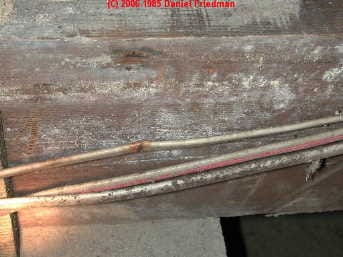 Once we have physically removed mold from a building surface by wiping or vacuuming, stains may remain. Don't panic about those marks. Microscopic examination of stained wood fragments will generally show that what remains in these wood cells are sterile fungal hyphae.
If the wood surface is cleaned thoroughly and building leaks, high moisture, or other water sources are prevented, keeping the humidity at the proper level, growth of problem mold on the cleaned surfaces is quite unlikely.
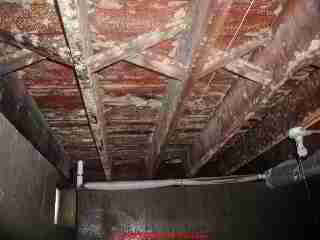
Our first photograph of mold on wood framing under a floor (above / left) as well as our page top photograph both show mold growing on wood framing lumber, subflooring, and even on electrical wiring insulating jackets in a wet basement before these surfaces had been cleaned by the mold remediation contractor.
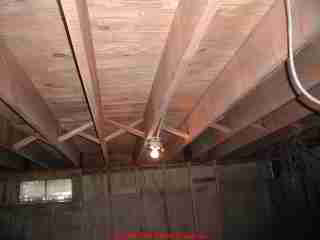
Our second photo (below) shows wood framing and subfloor that have been adequately cleaned, without any application of a fungicidal sealant.
At this inspection we found that although the mold cleanup looked complete to the naked eye, the remediation containment barriers had been removed before a successful mold remediation clearance inspection and test.
Testing in the crawlspace below the opened floor we found over 120,000 P/A spores/M3 - a rather high level of airborne mold that was identified as principally Penicillium or Aspergillus mold spores.
Technical note on Pen/Asp: When we have just the mold spores alone, as is common in a "mold air sample test", it can be difficult to determine which of these two mold genera is present so they're reported together as Pen/Asp or P/A.
The reasonableness of this reporting approach stems from the observation that both of these mold families produce many individual mold species that are particularly-harmful to humans (and other animals) because of their very small size - they're breathed deeply into the lungs and because the spores are often allergenic, pathogenic, toxic.
In the adjoining basement we found 7000/Pen/Asp spores per M3 of air. The rest of the house interior was low when tested immediately after containment removed. Our opinion was while cleaning had been well done, poor containment management meant that there was a high risk of recontamination.
Additional airing-out, air scrubbing, surface vacuuming, and re-testing in the adjoining basement were needed because of the mishandling of containment, despite good cleaning work.
Guide to Cleaning Mold from Smooth Wood Surfaces
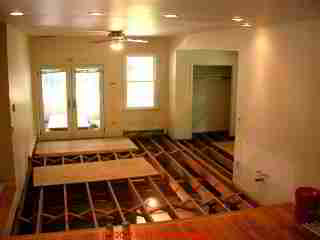 Perfectly adequate moldy-wood-surface cleaning may be accomplished by wiping or (where feasible) power-washing or media blasting.
Where wiping a moldy surface, take care not to spread moldy debris from a moldy surface onto a previously uncontaminated surface by making the mistake of re-using the same moldy rag over and over on all surfaces. Professionals use "steri-wiping" which takes care to avoid spreading moldy debris by always folding and using a clean side of the wipe when moving to a new spot.
Where the framing lumber is indoors or otherwise in a location where water spillage is a concern, wipe the areas of heaviest mold to remove any loose mold from the surface of the lumber.
Unless professional area-containment has been set up (barriers, negative air), do not use violent cleaning methods such as power-washing or sandblasting indoors, as you will spread moldy debris throughout the building and you'll increase the ultimate project cleanup cost.
Where the framing lumber is outdoors where water spillage and the creation of aerosolized mold spores is not an issue, pressure wash the infected lumber to remove surface mold.
"Cleaning" in this case can be simply wiping with a sponge wet with water or detergent.
The object of cleaning is to remove most of the loose moldy particles.
The object (except in medical facilities) is not to produce a particle-free sterile surface. However beware of cross-contamination. Wetting a rag and wiping a very moldy surface off is fine but if you then use the same dirty rag to wipe another fairly clean surface you may be in fact spreading moldy debris around.
A professional uses sterile wipes and folds to a clean side of the wipe for each wiping stroke. For a small homeowner non-critical project this may be overkill but think about and avoid spreading moldy debris by your cleaning procedure.
Watch out: An attempt to "kill mold" on moldy surfaces is not normally a proper nor sufficient approach to a moldy building. You need to remove the mold (cleaning) and correct the cause of its occurrence (fix leaks or moisture). Even if you could "kill" all of the mold organisms (which is doubtful) you may be leaving dead but still toxic or allergenic particles in the building.
See our detailed warnings about relying on bleach for "mold remediation"
in MOLD CLEANUP, BLEACH
Cleaning mold from irregular or hard-to-reach wood surfaces - media blasting
If mold needs to be removed from a roof deck through which roofing nails penetrate, hand wiping is not feasible. Power cleaning using spray equipment such as media blasting using baking soda or dry ice is very effective for these surfaces.
See our media blasting article at MOLD CLEANUP - MEDIA BLASTING - live link is given just below.
However spraying anything in an attic creates a secondary problem: contamination of building insulation. Our experience is that if attic conditions have been wet enough to produce problem mold justifying a professional cleaning of those surfaces, the insulation is probably contaminated and needs to be replaced.
Unless a building is being totally gutted to its framing, power-washing with water or any other liquid is problematic in a building attic where the procedure risks leaks into and wetting contents of the building below the work area. Dry-process spray cleaning works well in these areas. Typical high pressure sprays use baking soda or frozen C02, followed by HEPA vacuuming of the work area and probably of other building areas.
More Reading on methods for cleaning mold from difficult to access areas or removing mold from irregular building surfaces:
MOLD REMOVAL, MEDIA BLASTING (complete article, with illustrations) on the effectiveness of baking soda media blasting for cleaning fungal contamination in buildings, Daniel Friedman, Dennis Melandro, originally published in Indoor Environment Connections, Rockville MD, June 2003
Cleaning mold from wood trusses and cross-bracing
In an area of high levels of mold growth or moldy dust and debris, the irregular surfaces formed by wood trusses and also by older wood cross bracing between floor joists prevents thorough cleaning of surfaces and creates many dust collection points.
A similar construction detail where significant moldy dust reservoirs may be left in place is the upper surface of wood furring which has been nailed across the under-side of floor joists to support (now removed) ceiling tiles.
Because the surfaces formed by trusses and cross bracing can form a significant dust and debris reservoir, I always check these areas during a mold remediation clearance inspection. If work has been hasty or incomplete, these are among the first areas to be under-cleaned.
Spray process cleaning, media blasting (live link given above), and HEPA vacuuming are effective for these areas.
Sanding wood surfaces to "clean" mold
We often see remediators attempting to clean up mold by sanding surfaces, by hand or by power sander.
Sanding wood surfaces to remove mold is physically possible for smooth surfaces but in our opinion this is a slow, labor intensive procedure which is impractical for any large area cleanup. Spray processes are significantly faster and more thorough.
Sanding wood building surfaces by hand is
- probably completely unnecessary and
- may indicate inexperience or a response to an improperly informed and frightened building owner.
Clean the surface mold, dry the building, and if you like, use a sealant as discussed below.
The fungal material left inside of wood framing or sheathing and which forms visible stains is not going to affect building occupants provided the building is kept properly dry and free of leaks.
Even if you removed all of the stain by deep sanding, future building leaks will still \ produce new mold growth, so sanding is in most cases a wasted effort.
An exception we make to this general advice is where exposed beams are cleaned or sanded for cosmetic reasons. Still in that case media blasting cleans better and faster.
Just How Clean do Moldy Surfaces Need to Be?
Does the building need to be sterile? Is the object to reach a mold spore count level of zero?
No, the building does not need to be sterile, nor should you seek a "zero mold count". We have worked on cases where sterility was a necessary cleanup goal: medical facilities such as in operating rooms and treatment rooms. But in a normal office or home there is always some airborne mold along with lots of other airborne particles in building dust.
No washing, sanding, scraping, or other surface cleaning will remove all mold spores from wood where mold was previously found. It is unlikely that most construction materials, even when new, are free of mold spores, nor is "zero mold" a reasonable nor possible objective.
Cleaning moldy framing lumber followed by application of a sealant may be the most cost effective alternative (where removal of the lumber is cost-prohibitive or otherwise not possible). While lumber replacement with apparently "clean" new lumber may sound appealing, it is likely to be cost prohibitive and in fact may include its own mold when it is unloaded at the work site.
How Much Mold Must Be Removed - How Clean Do Surfaces Need to Be?
Following a properly executed mold cleanup, if there is a future mold problem in a building it is unlikely to be due to having left behind an "inoculation" of problem mold, and more likely to be due to a new building leak that was left unattended.
Good practice for the extent of and means of physical removal of moldy debris varies by material.
For drywall we remove all visibly moldy material and continue removing drywall to no less than the next adjacent stud, rafter, or joist.
For fiberglass or other porous building insulation which has been wet, we remove all suspect insulation and all insulation within 24" of the suspect material. However if moldy and wet conditions were long-standing in a building, removal of all of the insulation may be necessary.
For building insulation that has been exposed to dusty conditions or high levels of airborne mold it is often more cost effective to simply remove the material, clean the surfaces, and re insulate than to spend that same money on testing the insulation for mold.
Generally it is less costly to remove and discard more material than to "finish" the job and then discover that it needs to be done over again because the initial work was insufficient.
Framing lumber, or roof or wall sheathing that is not rotted does not need to be replaced. Unless framing lumber has been actually damaged, such as by rot, replacing it due to mold contamination is not justified and would be improper.
Physically clean moldy surfaces of the framing lumber and exposed roof or wall sheathing. No you do not normally need to demolish the roof or wall to treat the small remaining areas between the narrow edge of a rafter or wall stud and the roof or wall sheathing that is nailed against it.
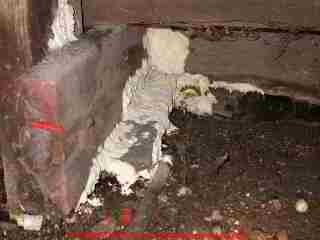
Our photo above shows wood supporting a basement stair that is surely rotted. We would remove and replace material like this rather than trying to clean it.
As with this stairway, there are other cases where it is less costly to replace a building material than to clean it.
Depending on the materials of which they were constructed, the cost to clean and re-seal the shelves in this moldy kitchen pantry may be greater than the cost of discarding and replacing the shelving.
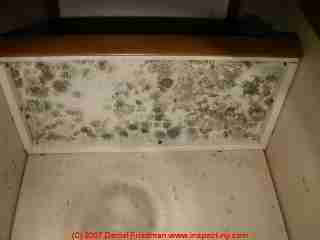
When we notice that the drywall on the pantry walls is also moldy we understand that the shelving has to be removed in order to remove the moldy drywall. We do not clean moldy drywall. It should be removed and the exposed framing surfaces cleaned.
Pantry gutting and reconstruction are a a more cost-effective approach to this particular mold cleanup project than any surface cleaning attempt.
Cleaning Mold off of Wood Flooring
Details about cleaning moldy wood flooring both when installed in buildings and when the flooring product has not yet been installed are discussed
at MOLD CLEANUP - WOOD FLOORING. Excerpts are just below.
Physically Clean Moldy Wood Surfaces, Dry The Wood Flooring Before Installation
Here we describe cleaning mold off of wood flooring products that have not yet been installed in a building.
Except where major costs are at issue that would be effected by a determination of the type of material or mold present, or where there are other reasons to test for mold, in our opinion testing is not necessary for small mold cleanup jobs (less than 30 sq. ft. of contiguous mold on a building surface).
In any case you can physically clean the surfaces to remove the mold.
Physically cleaning means wiping, scrubbing with a scrubby sponge and any household cleaner. Don't waste money or time with mold killing washes, it's not necessary, and using bleach or similar agents can create a cosmetic problem or a problem with future adhesion of finish coatings on the flooring upper surface after installation.
Watch out: be sure that your wood flooring has dried properly before it is installed or flooring shrinkage, gaps, or even more serious problems may occur.
The wood should be below 18% moisture before any coatings are applied, and it should be thoroughly acclimated to the building interior where it is to be installed before it is secured in place. This can mean storing the wood in the destination building for days or longer before it is installed.
If an exposed flooring surface remains stained even after surface mold has been removed, you will need to sand that surface - a step typically performed after the flooring has been installed.
Stains that might remain on the flooring underside will be of no cosmetic import and as long as the floor is installed indoors and not exposed to water or high moisture, mold growth should not be a problem.
If nonetheless you want to take steps for extra "mold proofing" you can, after cleaning and drying the wood, coat the underside with a fungicidal sealant, or even with simple quick dry shellac or a lacquer primer-sealer paint. The top flooring surface will be finished and sealed after installation unless you are dealing with a pre-finished flooring product.
If the exposed (upper) surface of the flooring material is moldy and if mold stains have penetrated the actual coating, for cosmetic reasons you'd need to sand through the coating and through the stain until the wood appearance is satisfactory.
Watch out: often mold-stains penetrate rather deeply into wood materials. While the stain does not itself signify an increased risk of future mold re-growth, its appearance may be unacceptable.
But deep stains can require removal of quite a bit of wood surface - something that can be a problem in wood flooring, and in particular if the flooring is a Vee-grooved pre-finished product.
See FUNGICIDAL SPRAY & SEALANT USE GUIDE
Reader Q&A - also see the FAQs series linked-to below
@inspectapedia.com.moderator, Thanks for the feedback. A roofing company proposed to strip all that affected wood (500 sq. ft) and replace the shingles.
I had doubts that this was overkill and you just confirmed it. Thanks!
@Fred,
Look carefully: if the decking (roof plywood) isn't rotted or delaminated then I don't see any justification for replacing it.
See the article series (that also discusses roof tearoffs) at
ATTIC MOLD
We don't replace plywood unless it's delaminating or rotting; clean what can be cleaned; HEPA Vac; inspect the ceiling side of drywall from attic - for mold;
You can add a fungicidal sealant if you want; but you'll need first to fix the roof venting system: fans blow to outside and there is good soffit intake and ridge exhaust venting.
From my very limited view of your photos I think there is a root problem of an un-vented attic
search InspectApedia for ROOF VENTILATION SPECIFICATIONS ...
And one last picture!
Another view of the problem
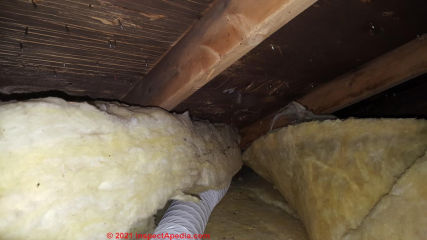
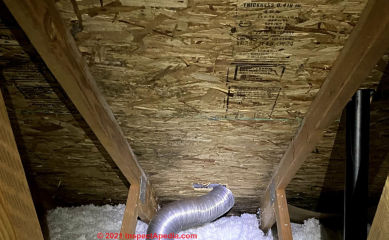
Hello, I recently discovered that both exhausts of my dryer and bathroom fan were simply not connected in the attic and created this big mold mess. Do I nned to replace the plywood or a decontamination would suffice?
@Lynne,
Wearing eye and respirator protection & gloves to be safe - appropriate where there is a lot of mold - (more than 30 sq.ft. of contiguous mold or a lot of moldy materials stored in a small space)
You or your worker will want to
1. remove stored items from the shed
2. Sort through items to identify those whose value makes them worth cleaning;
Do not bring moldy items into other buildings before they are cleaned.
3. Hard-surfaced items that you want to keep can be wiped clean with steri-wipes, wipes using any spray household cleaner, or equivalent;
Some hard surfaced items such as hand tools, garden tools, metal equipment - would not usually be moldy but all can be spray-washed outdoors;
4. Soft goods like carpets, upholstered furniture, insulation, can not be cleaned and are either thrown away, or for a very-valuable upholstered chair or sofa you'd have it stripped, cleaned, re-upholstered.
Protect cleaned items from any wet weather until they can be returned to the shed.
5. Clean visible mold from shed interior surfaces: spray cleaners, spray wash, hand wipe - whatever is convenient and easy;
6. Fix the leaks
7. Return cleaned, DRY items to the shed.
I have 2 outdoor shed that are used for storage of boxes and furniture. The older larger shed has a metal roof that has apparently been leaking for some time. Mold is evident on the things inside. Help!
Sorry, EthanH in the UK but to protect reader trust, we don't permit posting of advertisements.
However if you contribute technical content, even a simple question or suggestion, that can permit identifying you as a technical contibutor including your contact info if you wish.
@Will, that sounds right, it's certainly a common SNAFU
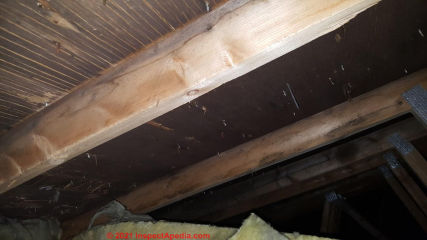
As a follow-up, the roofer informed me the bathroom exhaust fan was not properly attached to the tubing. Hence the accumulation of moisture/mold between these 2 rafters in particular! (and nowhere else except for adjacent to the skylight).
One last photo of black discoloration on underside of sheathing and white on the neighboring rafters. The roof repair is ongoing, thus the detached exhaust fan tubing.
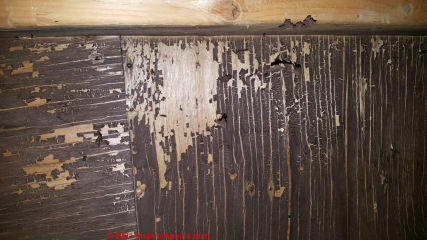
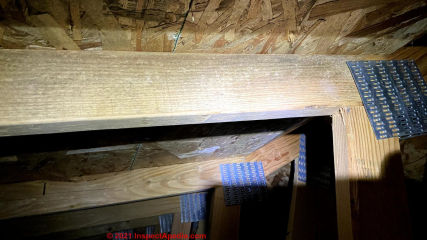
Here is another picture of a rafter with maybe "cosmetic" mold.
I recently discovered a leak adjacent to a skylight in my home. A roof contractor determined that both the workmanship of the roof install and quality of materials of the roof install adjacent to the skylight were deficient. He has replaced several areas of rotten sheathing.
There are a few spots on intact lumber where there may be residual mold. This picture shows a representative area on a rafter.
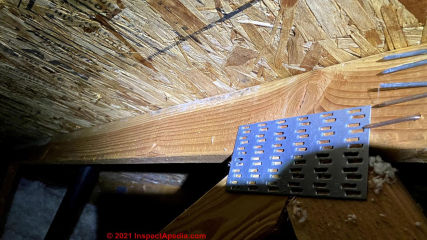
Now that the cause of moisture is presumably fixed, do these areas need to be treated?
@Brad,
first let's not make the mistake of thinking that all that we care about is black mold. There are hundreds of mold species that may occur in buildings and that can be harmful and that are not black but instead can be any other color such as white, green, red, brown.
It would be prudent to clean off moldy lumber before and closing your wall studs such as that in your photo. That reduces the risk of a larger and more serious mold contamination problem later.
Please take a look at the article above where we discussed cleaning moldy lumber.
I have a large custom home that was exposed to the weather in summer and only recently dried in. Some of the studs and plates were exposed for quite some time and showed black mold in the heat of the summer.
I recently visited the site to see the state of the studs and they were quite stained and had a moisture content of 10-12%. The house is now dried in, but the HVAC is not running continuously and we're in a wet winter climate. What would be the best next step to take? See attached picture. Thanks for the help!
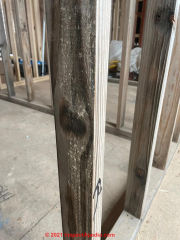
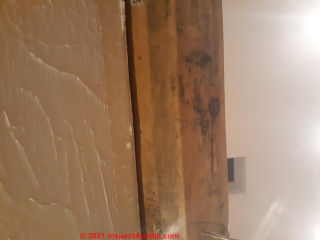 I would clean the surface, seal it, and look for a moisture source. Only if you find that water was leaking into building cavities would I urge more-destructive invasive inspection.
Really? Well there's more to say.
Often mold-stained wood or wood trim such as that shown in your photo can be easily surface-cleaned, but dark stains remain embedded in the wood itself. Those are not harmful provided you fix the conditions that caused mold growth in the first place.
But they're ugly.
If simple surface cleaning doesn't leave the wood looking nice and clean your options are
- paint the wood trim
- replace it
because in my opinion trying to sand out such deep stains rarely works.
Hi
We have recently been remodeling and tore out a drywall wall with fiberglass insulation..
we dont remember seeing any mold and there is no water source close to cause a leak but months later with the old studs still exposed we have what looks like mold growing...should we be worried about this
Louise
We need to find the cause and fix that.
We need to decide if the mold is really on the exterior of surfaces or if it's inside wall and ceiling or floor cavities;
Finished surfaces (use any household cleaner on hard surfaces, moldy soft goods like carpets that can't be put in the washer can't be cleaned of mold and are tossed out)
So just cleaning and sealing isn't going to be useful without that diagnosis.
I'd pick the worst-looking spot(s) or the most-suspect spots (where a leak into the van cavities is most-suspected) and do some deeper investigating - maybe removing a receptacle cover or other opening, or if necessary cutting a small opening to inspect the cavity.
You can post images using the "add image" button (one per comment) that might let me make more specific suggestions.
Do keep me posted.
We have discovered mold beginning to take hold in a converted van with woodwork constructed using untreated Baltic birch plywood. The problem begins as dark/discolored patches in parts of the van where things are stacked or enclosed, and thus poor air circulation. Some of these spots are now beginning to blossom with raised white mold.
Since the van is a living space, it's now winter in the Pacific Northwest, and the budget is limited, adequate cleaning, drying and sealing of the surfaces is going to be problematic. Can you make some recommendations?
I'm glad to assist. We value our UK readers very highly.
Hi Daniel. Thanks very much for your response, and for clarifying the issue for me: that cleaning mould from a surface by wiping, media blasting etc, still requires the underlying cause of the mould's growth to be addressed in order for the cleaning to be effective.
I live in the UK, and there really is very little in the way of information about, or even recognition of, the problem of mould in the home here, and so to have found your website has been invaluable.
Thank you
 You're right, Sean, thanks for asking as that shows that I need to be more clear.
Distinguish between cleaning or removing mold and cosmetic repair of leftover mold-stains in wood surfaces
You can wipe off surface mold on a wood surface, using any household cleaner. That is the first and most-appropriate step in removing a mold problem that is a health or IAQ concern for building occupants. For a proper repair we must also find and fix the cause of mold growth.
That does not address the cosmetic concern about remaining mold-stains, as surface wiping can not remove mold stains that are deeper into the wood surface.
However, in my experience, the remaining, stained-wood is **only** a cosmetic issue, that is, it is harmless, not releasing mold spores into the environment, and not producing or growing more mold, ** provided ** we also dry out the area or fix leaks or high moisture - the conditions that would have caused mold growth in the past.
What remains, then, is a cosmetic issue.
In some cases, for cosmetic reasons such as on a floor or on exposed wood beams, we might want to remove more or try to remove all of that stain.
In restoring old heart pine wood flooring such as the floor shown above (3 Willowbrook Hgts Pok) I have gone so far as to swab small stain spots with a Q-tip dipped in household bleach, watched the stain lighten until it matched the surrounding wood, then cleaned off the bleach, dried the floor, and stained and re-finished that area.
You can see that one must be careful not to leave bleach on the surface for too long as well as taking care not to use a stronger bleach solution than necessary. If you do over-bleach, as I did in a couple of spots, you may be able to recover by cleaning off the bleach thoroughly and staining to match the surrounding flooring.
The more-successfully bleached spots cannot be seen at all on the flooring example I give above.
So it's possible to successfully "restore" such wood but it's labor intensive and benefits from experience and a light touch.
If the stain is deep into the wood, beyond what can be reached by media blasting
details at MOLD REMOVAL, MEDIA BLASTING
or sanding, then we're left with either complete replacement of the wood component - not usually cost-justified -
or we have to clean as much as we can and live with the stain -
or we have to give up on the exposed natural wood and instead coat the wood with a sealant or stain or even a paint.
FUNGICIDAL SPRAY & SEALANT USE GUIDE sold in either pigmented or clear forms
Really? Well, no. For leftover mold stains on wall studs in a basement whose walls are to be covered in drywall and perhaps later paneling, there is no need to remove cosmetic leftover stains once you have cleaned off surface mold and have also made sure that there are no moisture or leak sources that will invite furthe rmold growth.
For peace of mind or "insurance" you can opt to seal the studs with a fungicidal sealant, as that reduces future moisture uptake and would retard mold growth should there be high moisture in the area later-on.
Thank you for asking; let me know if this explanation leaves you with further questions, criticism, or suggestions.
Hi. On your webpage titled How to Clean Mold off of Lumber or Plywood you describe how mould can be removed effectively from timber by wiping off, but later on the same page, in response to a reader's question, it's stated that wiping off is an incomplete method of mould removal.
I've relied on your website for reliable and sensible advice in tackling my own mould problem, and found it a uniquely valuable resource in my attempts to remedy my own property's mould problem.
Have I misunderstood this apparent contradiction?
Best regards
Sean
 Joe
Joe
spraying with bleach is generally not necessary and not, in all respects, effective in dealing with mold: you may leave toxic particles around even if they're "dead" - see details
at MOLD CLEANUP, BLEACH - not an adequate mold remediation approach b
The article above gives a reasonable procedure:
Physically clean visibly-moldy surfaces, let things dry out, and fix the leak or water or moisture source.
If you want extra peace of mind, though it's not technically necessary, you can spray the exposed, cleaned moldy wood with a fungicidal sealant as we discuss in this article series. Live links are given above at the more-reading section.
How do I remove the surface mold? Should I stub it? I've already sprayed it with bleach water mix but it doesn't seem to be going away.
My basement is high humidity around 50% I've recently put on a dehumidifier that's we're all this started.
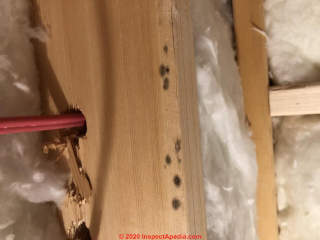
Try a closer sharper image;
That looks to me like black spots remaining in mold wood that sported black mold growth possibly even before milling, else after some cleaning was done.
In any case, the best you can do is remove the surface mold, assure that the wood and other materials are dry and that there are no leaks or trapped moisture or humidity problems.
If you want extra peace of mind, though it's not technically necessary, you can spray the exposed, cleaned moldy wood with a fungicidal sealant as we discuss in this article series. Live links are given above at the more-reading section.
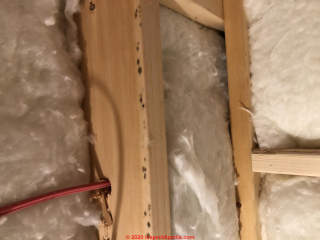 I'm pretty sure it's mold, there's a bunch of black spots across the wood in a few spots in my basement. If you want I can send the picture another way so it could come out clear.
The wood has not been wet since killing and I can't seem to find any other mold on any other surface beside the wood on the ceiling.
Joe
On enlargement the photo is a little blurry so I'm not sure what those dark spots are. Are you sure it's mold?
Has that wood been wet since milling or since construction?
Is there mold growth on any other surfaces such as drywall, cavity side of wall sheathing, insulation facings, drywalll?
I have mold in my unfinished basement, My house is 4 years old so the mold growth is minimal but still in a few spots on the wood on the ceiling of my basement.
I sprayed it with bleach and water about 3 days ago and it doesn't seem like it's doing much. Should I scrub it too?
Rod:
What's the mold actually growing on? Exposed OSB - not intended for permanent exposure to the weather - can be cleaned using either simple cleaners, followed by drying and sealing with a suitable coating, or more aggressively with media blasting (not normally justified unless for cosmetic reasons)
But the underlying cause of mold growth is what needs to be addressed: leaks, water, moisture traps, lack of sunlight - of which you'd focus on fixing any leaks and weatheproofing the the exterior.
How to eliminate mold from exterior osb walls that have closed cell spray foam as insulation on the inside
Never the less you need to remove the mold and fix the cause of its growth. About doctor's you need to be guided by your primary care physician.
If you have Penicillium/Aspergillus in your basement & Cladosporium upstairs, the penicillum/asp become a vapor.
It was blowing through the heater vents into son's room & gave bothh f us bhorrible migraines & sudden onset Diabetes, plus my brain carotid artery, despite statin use jumped from 50% in 2017 to 69% on my r. dominant side one year later. I have a child with autism I am still raising, I'm dissappearing & I cannot afford all of the super expensive mold removal doctors as I am now on Disability from work due to this problem.
IMAGE LOST by older version of Clark Van Oyen's useful Comments code - now fixed. Please re-post the image if you can. Sorry. Mod
Reader Question: how should we clean moldy wood framing in our new home
We are building a new home, the wood framing has mold, the walls are still open. How should the builder clean or remove the mold? - Linda Lewis 4/7/2013
Reply:
Thanks for the question Linda.
If the mold is ONLY the cosmetic black mold that we describe
at BLACK COSMETIC MOLD then it really is only cosmetic and could be left in place.
There are two difficulties with this:
- First you may have trouble recognizing the cosmetic mold I describe in that article, though sometimes the growth patterns make it clear. To address this you could spend roughly $50. to send a representative tape sample of the mold to a mold test lab for confirmation.
- Second, while the black mold I describe (sapstain mold, bluestain mold, Ceratocystis or Ophistoma) is indeed harmless on framing lumber and virtually always came in on the lumber from the lumber yard, also one wants to
Watch out: in some cases, particularly on lumber that has been wet, or on treated lumber, my own field and lab tests have found Aspergillus sp. and Penicillium sp. growing among the harmless black mold.
So we might want to clean the lumber.
- IF you are in time in the project - say when just rough-in framing has been done, (this is the case you describe in your message) it's trivial to use a deck cleaner and power-wash the questionable framing lumber or sheathing.
Just be sure that you let everything dry completely before installing insulation, drywall, vapor barriers, etc. The contractor won't like the schedule delay - it'll take some negotiating and perhaps job planning.
- If you are not in time, that is, if the building has been enclosed, the problem is we don't want a lot of water inside creating secondary problems - like warping subflooring. In that case you might have to use dry media blasting.
See MOLD REMOVAL, MEDIA BLASTING
- Also see MOLD CLEANUP - WOOD FLOORING where we describe removing mold from wood flooring surfaces.
I tend to stay away from labor intensive approaches (hand sanding) and from incomplete approaches (wiping off). Keep us posted and send along some photos if you can (by email to the page top or bottom CONTACT link) as what you learn may help others.
This article series includes advice on cleaning mold found on surfaces of un-finished wooden building materials such as framing lumber (rafters, floor joists, wall studs), and building roof, wall, and floor sheathing such as plywood, tongue-and groove pine boards, and other structural wood surfaces in buildings.
We discuss the pros and cons of using fungicidal sealants and bleach on wood surfaces and give sources and list types of those products. We also discuss common errors made when cleaning wood surfaces, such as relying on bleach or performing expensive and unnecessary cleaning on cosmetic black mold on wood surfaces.
Reader Question: is it OK to apply a sealer or wood preservative over black stains on plywood roof sheathing?
Last September I had a new garage roof fitted and within 7 months the plywood used inside developed black mould spots. The company that fitted the roof said it was caused by condensation. Having wiped the roof with a mild detergent I was left with black stains on the plywood. I would like to know if it would be ok to put a wood preservative on it despite the stains - don't want it to come back.
Would appreciate your advise? - [Anon by private email 23 July 2015]
Reply:
Yes you can apply a wood preservative, leaving cosmetic black stains under the preservative.
But if you do not find and fix the cause of condensation (removing a water source and/or improving ventilation) I'd still expect future trouble. You may find stains or mold appearing on other wood or mold-friendly surfaces in the same area if indoor moisture levels are high, or if there is building insulation present that may become mold contaminated.
See HUMIDIFIERS & HUMIDITY TARGET
See ROOF VENTILATION SPECIFICATIONS
...
Continue reading at MOLD CLEANUP - WOOD FLOORING or select a topic from the closely-related articles below, or see the complete ARTICLE INDEX.
Or see MOLD CLEANUP of WOOD, FAQs - questions about how to clean off moldy wood, posted originally at this article
Or see these
Recommended Articles
- BLACK COSMETIC MOLD - not all black mold is harmful
- FUNGICIDAL SPRAY & SEALANT USE GUIDE - sprays and sealants used after proper cleaning reduce further risks
- MOLD CLEANUP, BLEACH - not an adequate mold remediation approach
- MOLD CLEANUP - WOOD FLOORING - how to remove mold from wood flooring surfaces
- MOLD CLEANUP - WOOD FRAMING & PLYWOOD
- MOLD REMOVAL, MEDIA BLASTING - good approach for irregular or hard-to-clean surfaces
- SIDING, WOOD CLEANERS, STAINS, PAINTS how to remove stains on siding & how to choose the proper paint or stain coating
Suggested citation for this web page
MOLD CLEANUP - WOOD FRAMING & PLYWOOD at InspectApedia.com - online encyclopedia of building & environmental inspection, testing, diagnosis, repair, & problem prevention advice.
Or see this
INDEX to RELATED ARTICLES: ARTICLE INDEX to MOLD CONTAMINATION & REMEDIATION
Or use the SEARCH BOX found below to Ask a Question or Search InspectApedia
How To Clean Mouldy Fridge Seals
Source: https://inspectapedia.com/mold/Clean_Moldy_Wood.php
Posted by: marshallfrochat.blogspot.com
0 Response to "How To Clean Mouldy Fridge Seals"
Post a Comment